About Burdock
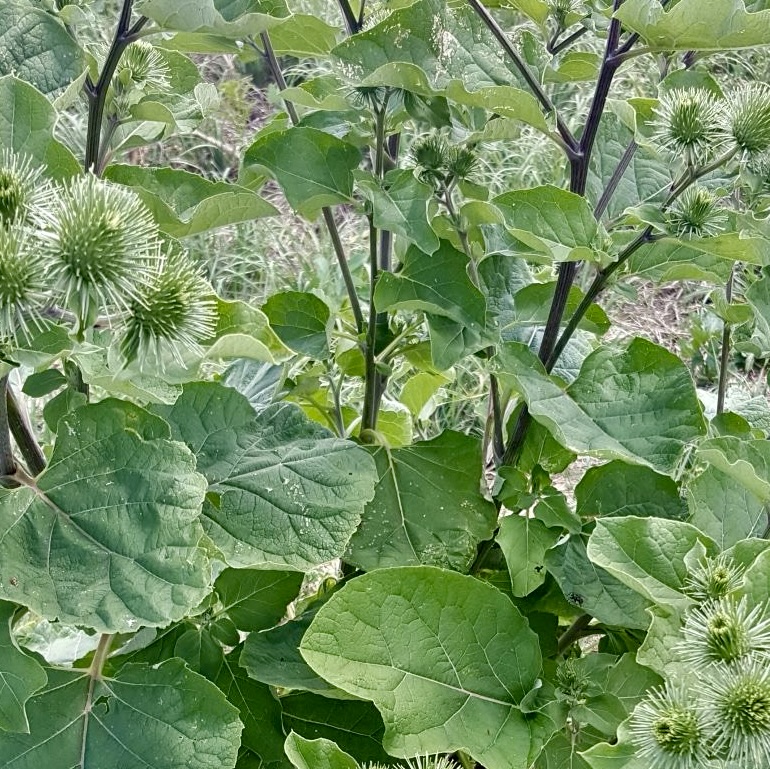
Burdock (Arctium lappa) is a striking biennial with large, heart-shaped leaves and thistle-purple flowers that ripen into the clinging burrs most of us remember from childhood walks. Those same burrs famously inspired the invention of Velcro, after a Swiss engineer noticed how readily they clung to his dog's coat.
Although often considered a weed, Burdock has a long and respectable history as both a vegetable and an important traditional medicinal herb. Its deep taproot has been valued for centuries in European and Asian herbal traditions, and in Japan the young roots are still a familiar vegetable at the market.
Although often overlooked, Burdock is a remarkably architectural plant. Its enormous leaves, tall flowering stems and distinctive burrs make it a striking feature in the herb garden, proving that some of our most useful herbs are also among the most impressive to grow.
Uses & Benefits
Burdock is a traditional culinary and medicinal herb, valued equally for its edible roots and its long history of use in supporting skin and liver health. Today it is appreciated by gardeners and cooks alike for the humble, nourishing qualities it has offered for generations.
Culinary Uses
The young roots are harvested in the first year, before the plant flowers, and are widely used as a vegetable in Japanese cooking, where they are known as gobo. They can be stir-fried, added to soups and stews, or simply cooked as a root vegetable. The young leaf stalks can also be eaten when peeled and cooked, offering a mild, earthy flavour.
Medicinal Uses
Burdock is one of the classic traditional herbs used to support healthy skin and normal liver function. It has a long history in Western herbal medicine, where it was valued as a gentle nourishing root. It should not be regarded as a substitute for professional medical advice.
Growing & Harvesting
Growing
Burdock prefers full sun and deep, fertile, well-drained soil where its long taproot can develop properly. It is a biennial, producing a rosette of large leaves in the first year and flowering in the second on tall branching stems. It readily self-seeds if the burrs are left to mature, so I usually remove most of the flower heads before they set seed to keep it from spreading too freely.
Harvesting
The roots are best harvested during the first autumn, before the plant flowers, while they are still tender. Wash them thoroughly, slice if desired, and dry them on racks in a warm, airy place away from direct sunlight. Once completely dry, place them in a paper bag for a short time to ensure any remaining traces of moisture have disappeared before transferring them to an airtight plastic container and storing them in a cool, dark cupboard.
Cautions
Burdock is generally safe when the roots are enjoyed as a vegetable in moderation. Anyone who is pregnant, breastfeeding, taking medication or considering medicinal use should seek professional advice first. Foraging wild Burdock is best avoided unless you are certain of identification, as it can be confused with other plants.