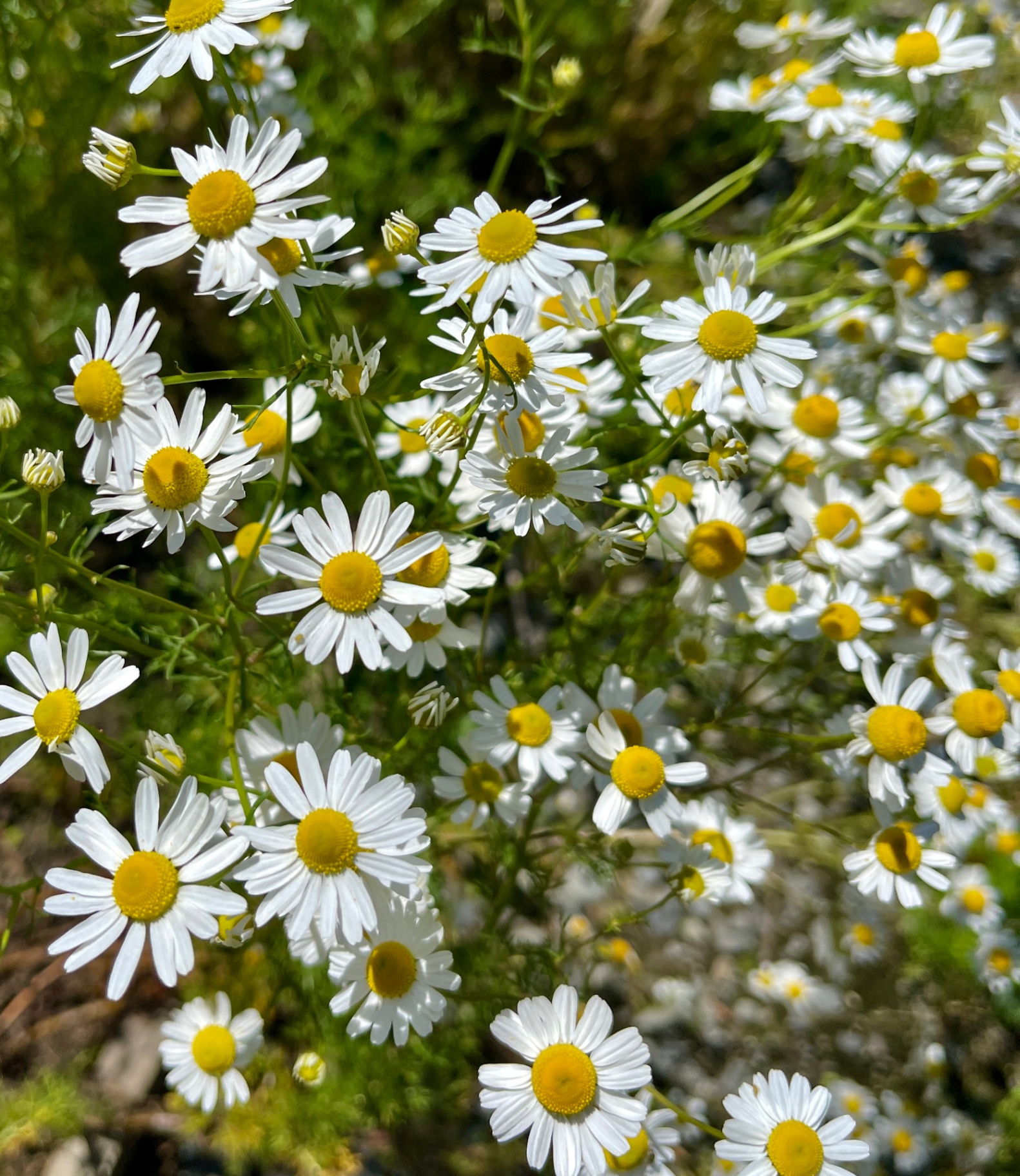
About Chamomile
Chamomile (Matricaria chamomilla), often known as German Chamomile, is one of the world's oldest and best-loved medicinal herbs. Native to Europe and Western Asia and a member of the daisy (Asteraceae) family, it has been valued since the time of the Ancient Egyptians, Greeks and Romans. The Egyptians considered it a sacred plant associated with the sun, an idea that seems only natural when you see its cheerful golden centres ringed with white petals.
There are two Chamomiles commonly grown in gardens. This page refers to German Chamomile (Matricaria chamomilla), an annual herb prized for its abundant flowers and widely regarded as the preferred species for harvesting and drying as a herbal tea. Roman Chamomile (Chamaemelum nobile) is a low-growing perennial with a similar apple fragrance and many of the same traditional uses, but it is more often grown as an ornamental groundcover or edging plant.
The plant itself is delicately beautiful. Chamomile forms a low, branching mound of finely divided feathery foliage, topped through the summer months with an abundance of small daisy-like flowers. Each bloom carries a cone of pale yellow at its centre, surrounded by a ring of white petals that gently reflex as the flower matures. Brush past the leaves and you are met with a sweet, apple-like fragrance — and it is this scent that gives the herb its name, for "Chamomile" comes from the Greek khamaimelon, meaning "ground apple".
For generations, Chamomile has gathered a quiet folklore around it. Traditional gardeners long spoke of it as the "plant's physician", a herb believed to improve the health of any neighbouring plant it grew beside. Whether there is truth in the old belief or not, it speaks to the affection and respect this gentle herb has always inspired.
Today, Chamomile remains one of the world's most widely enjoyed herbal teas and one of the gentlest herbs for both the garden and the home — a soft, generous plant that asks very little and gives a great deal in return.
Uses & Benefits
Chamomile has long been valued as one of the gentlest and most versatile medicinal herbs. It is widely used as a calming tea to support relaxation, is traditionally used to aid digestion after meals, and has also been used externally in skincare preparations and soothing herbal baths.
Culinary Uses
The flowers are mainly used to make a soothing herbal tea, but they may also flavour syrups, honey, jellies, desserts and herbal blends. Fresh flowers can be scattered sparingly over salads or desserts as an edible garnish, their faint apple-like sweetness bringing a delicate finishing touch to summer dishes.
Medicinal Uses
Chamomile has traditionally been used as a relaxing herb to help ease nervous tension, encourage restful sleep, soothe digestion and support minor digestive discomfort. A cooled cup of Chamomile tea has also long been used as a gentle skin compress. These uses are based on long-standing herbal practice and are not a substitute for professional medical advice.
Growing & Harvesting
Growing
Chamomile is an easy annual that thrives in full sun and well-drained soil. It is unfussy and generous, self-seeding readily if a few flowers are allowed to mature and set seed. Its long season of small daisy-like flowers attracts bees and other pollinators, making it ideal for herb gardens, cottage gardens and vegetable beds alike.
Harvesting
Harvest the flowers on a dry morning, once any dew has lifted, choosing blooms that are fully open and at their peak. Spread them in a single layer on drying racks in a warm, airy place out of direct sunlight. Once they are completely dry and crisp, transfer them to a paper bag for a short time if required to ensure all remaining moisture has dispersed, before storing them in airtight containers in a cool, dark cupboard, where they will keep their gentle fragrance for many months.
Cautions
Chamomile is generally regarded as very safe when enjoyed as a tea or culinary herb. People with known allergies to plants in the daisy family (Asteraceae) should use caution, and anyone who is pregnant, breastfeeding or taking medication should seek professional advice before using it medicinally.