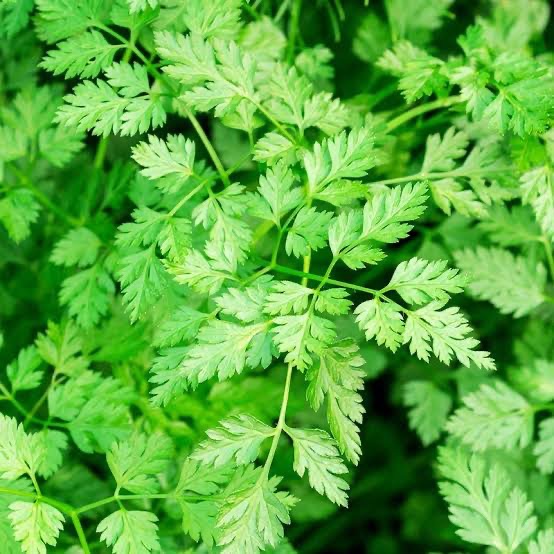
About Chervil
Chervil (Anthriscus cerefolium) is a quiet but remarkably rewarding herb, prized for its delicate, fern-like leaves and a gentle flavour that sits somewhere between parsley and anise. Native to the Caucasus region and Western Asia, it gradually found its way westward and became an important herb throughout Europe, where it has been grown in kitchen gardens for centuries.
Chervil's reputation was made in France, where it earned a permanent place in the kitchen as one of the classic fines herbes — the traditional blend of finely chopped fresh herbs combined with parsley, chives and tarragon. Long associated with French spring cooking, it brings a soft, refined sweetness to egg dishes, soups, dressings and early vegetables, and is almost always added at the very end of cooking so that its fragile flavour is not lost.
In the garden, Chervil is a softly handsome plant. Its finely divided leaves are a fresh, pale green and lacy in appearance, while in early summer it carries small, delicate white umbels of flowers. As a member of the carrot family (Apiaceae), those flowering heads are valuable for attracting beneficial insects, drawing in the hoverflies, lacewings and parasitic wasps that help keep a garden in natural balance.
Uses & Benefits
Chervil is valued chiefly as a culinary herb, where its delicate, aromatic leaves bring a gentle warmth and refinement to a wide range of dishes. It has also been used traditionally as a mild medicinal herb, although its chief importance has always been in the kitchen rather than the apothecary.
Culinary Uses
Chervil is best used fresh, as drying greatly reduces its delicate flavour. Add the finely chopped leaves at the very end of cooking, or scatter them over a finished dish, so that their subtle anise sweetness is preserved. Chervil is a classic partner to eggs, fish, poultry, soups and creamy sauces, and is the defining note in the traditional French fines herbes blend. It also pairs beautifully with spring vegetables such as asparagus, peas and new potatoes, and makes a lovely addition to light vinaigrettes and herb butters.
Medicinal Uses
In traditional herbal practice, Chervil was sometimes used as a gentle digestive aid and a mild diuretic, and was thought to support the skin and circulation. These uses are rooted in long-standing folk practice rather than modern medical evidence, and Chervil should not be regarded as a substitute for professional medical advice. Today it is almost always enjoyed simply as a culinary herb.
Growing & Harvesting
Growing
Chervil is a cool-season annual that prefers a position in partial shade with moist, well-drained soil. In warm New Zealand summers it is inclined to bolt to seed, so sow seed successionally every few weeks through spring and again into early autumn to keep a steady supply of fresh leaves. Simply scatter seed thinly where it is to grow and keep the soil moist until germination, which is usually quick. A light mulch will help keep the roots cool and extend the harvest.
Harvesting
Pick the young leaves frequently and before the plant begins to flower, as the flavour is at its best while the growth is soft and tender. Chervil is best used immediately after picking — its delicate leaves do not store well and lose their fragrance quickly once cut. If you do need to keep a small bunch for a short time, place the stems in a jar of water in the refrigerator, but for the true flavour of Chervil there is no substitute for stepping out to the garden and picking it fresh.
Cautions
Chervil is generally regarded as safe when enjoyed as a culinary herb. As with all herbs used for medicinal purposes, it should not replace professional medical advice, and anyone who is pregnant, breastfeeding or taking medication should seek guidance before using it medicinally.