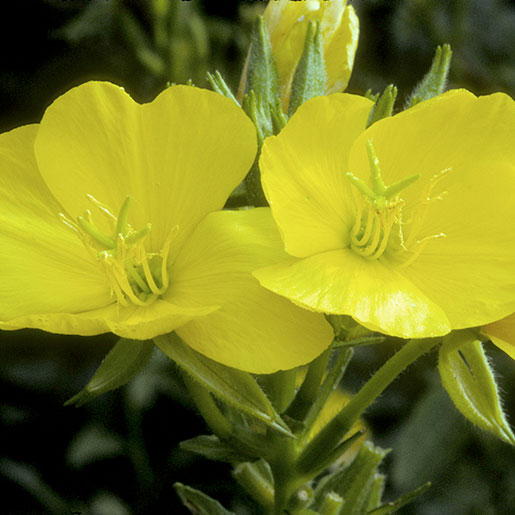
About Evening Primrose
Evening Primrose (Oenothera biennis) is a hardy biennial native to North America that has become naturalised throughout Europe, Britain and New Zealand. During its first year it forms a low rosette of leaves before sending up tall flowering stems in its second summer, often reaching well over a metre in height.
One of Evening Primrose's most fascinating features is that its tightly furled buds begin to unfurl as daylight fades, often opening completely in just a few minutes. Their sweet fragrance attracts night-flying moths and other evening pollinators, giving the plant its memorable common name.
Introduced to Europe during the seventeenth century, Evening Primrose soon became valued for both its beauty and medicinal qualities. It was once affectionately known as "The King's Cure-all," reflecting the high regard in which it was held as both a useful food and medicinal plant.
Today Evening Primrose brings gentle beauty to the summer garden, attracting bees by day and moths by night. Its remarkable evening display reminds us that some of nature's most magical moments happen as the sun begins to set.
Uses & Benefits
For generations, Evening Primrose has been appreciated for the oil contained within its seeds, which is naturally rich in gamma-linolenic acid (GLA), an essential omega-6 fatty acid. Today, Evening Primrose Oil remains one of the best-known herbal supplements, particularly for supporting women's wellbeing.
Beyond its herbal reputation, Evening Primrose is a delightful wildlife plant. Its flowers provide nectar for bees during the day before opening fully at dusk to attract moths and other evening pollinators, making it one of the few garden plants that truly comes alive as daylight fades.
Culinary Uses
Although Evening Primrose is grown mainly for its ornamental beauty and medicinal value, the bright yellow flower petals are edible and make a cheerful addition to summer salads. They can also be scattered over desserts or used as a simple garnish, adding both colour and a delicate touch to seasonal dishes. The leaves and roots have been eaten historically, but today it is the flowers that are most commonly enjoyed in the kitchen.
Medicinal Uses
Evening Primrose is valued primarily for the oil extracted from its seeds, which is naturally rich in gamma-linolenic acid (GLA), an essential omega-6 fatty acid. Evening Primrose Oil has long been used as a traditional herbal supplement, particularly in support of women's wellbeing and healthy skin. Indigenous peoples of North America also made use of different parts of the plant long before it became established in European herbal medicine. Today, the seed oil remains the plant's best-known and most widely used herbal preparation.
Growing & Harvesting
Growing
Evening Primrose is easy to grow from seed and thrives in full sun and well-drained soil. Once established it tolerates dry conditions well and is perfectly suited to informal borders, cottage gardens and wildlife plantings. As a biennial, the first year is devoted to producing a strong rosette of leaves, with flowering taking place in the second year. If a few seed heads are left on the plants each autumn, Evening Primrose will often self-seed gently around the garden, creating relaxed natural drifts that return year after year with very little effort.
Harvesting
The flowers can be picked throughout summer for fresh use, herbal teas or gentle drying, while the seeds are harvested once the seed capsules have matured and dried naturally on the plant. Harvest on a dry day and allow the seed heads to finish drying in a warm, airy place before collecting the seeds. If drying flowers, lay them out carefully on drying racks away from direct sunlight. Once completely dry, store them in paper bags for a short period before transferring them to airtight plastic containers and keeping them in a cool, dark cupboard.
Cautions
Evening Primrose is generally regarded as a safe herb when used appropriately. However, Evening Primrose Oil supplements may not be suitable for everyone, particularly those taking certain medications or managing epilepsy or other neurological conditions.
As with all herbal remedies, anyone who is pregnant, breastfeeding or taking prescribed medication should seek advice from a qualified healthcare professional before using Evening Primrose medicinally. Herbal remedies should be used in moderation and should not replace professional medical care where required.