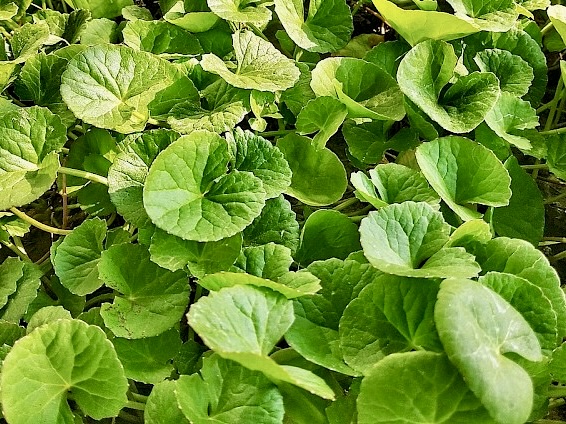
About Gotu Kola
Gotu Kola has been treasured for thousands of years in Ayurvedic and Traditional Chinese Medicine, where it has long been associated with longevity and vitality throughout Asia. In Sri Lanka the leaves were traditionally eaten fresh as a daily tonic, while in China the herb was prized as a restorative for body and mind. Its enduring reputation has made it one of the most respected herbs in the traditional medicine of the region.
A low-growing, creeping herb, Gotu Kola spreads gently on slender stems, rooting as it grows to form a lush mat of rounded leaves. In warm, humid climates it remains evergreen, while in Canterbury it dies back through winter before returning with fresh growth in spring. Although it enjoys warmth and moisture, it has proved surprisingly resilient when given a sheltered position.
Uses & Benefits
Gotu Kola is grown as much for its long place in traditional healing as for its soft, carpeting beauty. Its fresh leaves are mildly bitter and slightly sweet, valued both as a simple food and as a gentle tonic, while its low, spreading habit makes it a useful ground cover in warm, sheltered spots.
Culinary Uses
The tender young leaves of Gotu Kola can be eaten fresh, most simply added to salads where their mild, slightly bitter flavour pairs well with sharper greens. In Sri Lanka and parts of Southeast Asia a handful of leaves is traditionally stirred into a sambol or added to rice dishes at the end of cooking. A few leaves can also be blended into a green smoothie or stirred into a light soup, though the leaves are best used raw or only briefly warmed to preserve their delicate flavour.
Medicinal Uses
In traditional practice, Gotu Kola has long been valued for supporting the skin, circulation and the nervous system. Fresh leaves were traditionally eaten to promote calm and clear thinking, while preparations of the herb have been used in balms and compresses to soothe minor wounds and support skin healing. Modern herbalists continue to respect these long-established uses, although the herb should always be used thoughtfully and alongside appropriate professional advice.
Growing & Harvesting
Growing
At The Herbal Garden, Gotu Kola is grown in terracotta pots inside the greenhouse, where it enjoys the warm, sheltered conditions it needs to thrive. The pots are kept consistently moist, as the plant dislikes drying out, and the rich, fertile compost encourages a steady supply of fresh leaves throughout the growing season.
Although it is a tropical herb, growing it in containers makes it much easier to provide the warmth and protection it needs in Canterbury. In winter, growth slows considerably, but once the greenhouse begins to warm in spring, fresh new leaves quickly appear again.
Harvesting
Pick the young, tender leaves as you need them through the growing season, choosing the freshest growth for the kitchen. They are best gathered in the morning once the dew has dried, when their flavour is at its cleanest. For drying, spread the leaves in a single layer in a warm, airy place away from direct sun, then store them in an airtight glass jar once they are completely crisp. The leaves are most valued fresh, so a small daily harvest is the simplest way to enjoy them.
Cautions
Gotu Kola is generally regarded as a gentle herb when used appropriately in small, culinary amounts. Because concentrated preparations may affect the body in different ways, larger or more concentrated preparations are best approached with care and with the guidance of a qualified herbalist or healthcare professional. As a precaution, Gotu Kola is not recommended during pregnancy or while breastfeeding. As with all herbs, Gotu Kola should complement a healthy lifestyle and is not a substitute for professional medical advice or treatment.