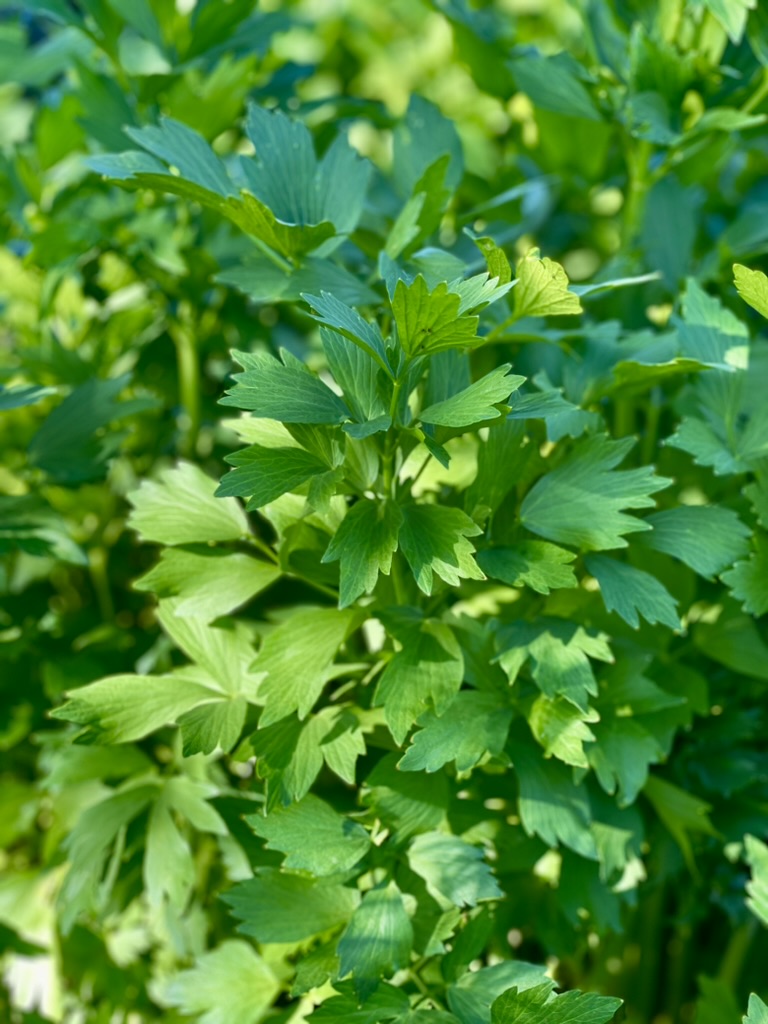
About Lovage
Lovage is a tall, hardy herbaceous perennial native to southern Europe, where it grows into an impressive architectural plant. Its glossy green, celery-scented leaves rise on sturdy stems, and in early summer it sends up tall flowering stalks topped with broad umbels of yellow-green flowers that draw pollinators from all corners of the garden.
Lovage was cultivated by the Romans and later became an important herb in medieval monastery gardens, where it was valued both as a flavouring and as a medicinal herb. Travellers were said to chew the leaves or seeds to help combat fatigue on long journeys, which lends this stately plant a quietly romantic place in herbal history.
Its bold celery-like flavour and striking presence continue to earn it a place in modern herb gardens, where a single mature plant is often quite enough to supply a whole kitchen.
Uses & Benefits
Culinary Uses
The leaves, young stems, seeds and roots are all edible. The fresh leaves have a rich celery flavour and are excellent in soups, stews, casseroles and stocks, where a little goes a long way. Young hollow stems can be used as edible straws for tomato juice or Bloody Mary cocktails, lending a gentle celery note to the drink, while the seeds can be dried and used as a seasoning. One of the simplest ways to enjoy Lovage is to dry the leaves and grind them into a fine herb powder. Unlike many dried herbs, ground Lovage retains a remarkably vibrant green colour and adds a rich, savoury flavour to soups, casseroles, stocks and everyday cooking.
Medicinal Uses
Lovage is a traditional European herb that has long been valued to support healthy digestion and as a gentle diuretic. It was also traditionally used to support urinary health. These are traditional herbal uses passed down through generations rather than proven medical treatments, and they are best understood as part of the plant's long folk history.
Growing & Harvesting
Growing
Lovage is an easy, long-lived perennial that thrives in fertile, moisture-retentive soil in full sun or partial shade. Once established it forms an impressive clump, often reaching well over a metre in height, and returns reliably each spring. Lovage grows happily in the herb garden, where its fresh leaves are harvested regularly throughout the growing season.
Harvesting
Young leaves are best picked regularly from spring onwards to encourage fresh growth. Larger stems can be harvested through summer, while seeds may be collected once they ripen. If roots are required, they are traditionally lifted from mature plants in autumn. Leaves can be picked regularly throughout the season and dried on racks in a warm, airy place. Once completely dry, remove the leaves from the stems, store them in a paper bag for a short time, then transfer them to an airtight container. The dried leaves can be ground into a vibrant green herb powder that keeps its colour exceptionally well and is ideal for everyday cooking.
Cautions
Lovage is generally regarded as a safe culinary herb. Because of its traditional diuretic properties, medicinal use may not be suitable during pregnancy or for people with certain kidney conditions, so professional advice should be sought before medicinal use.