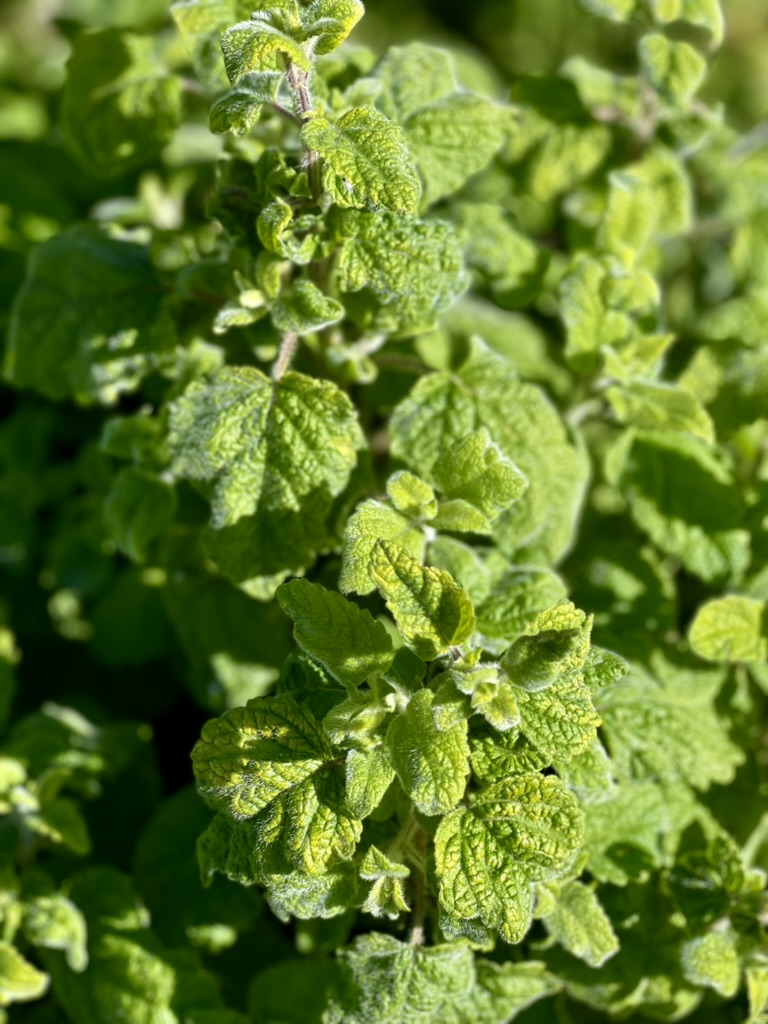
About Orange Balm
Orange Balm is a beautifully scented ornamental form of Lemon Balm, valued above all for its golden-green foliage and fresh citrus fragrance. Like its better-known relation, it belongs to the mint family (Lamiaceae), sharing the same square stems, gently toothed leaves and eager, spreading habit — though here the leaves have a softer golden-green colour that brightens the border throughout the growing season.
Through summer the plants throw up airy spikes of small white flowers that hum with bees and other pollinators, making Orange Balm a genuinely useful companion in both the herb garden and a shaded border. Its bright foliage adds colour where many herbs are plain green, lifting a quiet corner long after the first flush of spring flowers has faded.
Although it is closely related to Lemon Balm, Orange Balm is generally grown more for its ornamental beauty and fragrance than for culinary or medicinal use. The leaves carry a gentle, citrus scent at the lightest touch, and the plant brings a soft, golden warmth to the garden that earns it a place on looks alone.
Uses & Benefits
Culinary Uses
The leaves are edible and can be used much like Lemon Balm — a few torn into a fruit salad, steeped in a cool drink, or scattered over a summer pudding for a gentle citrus note. The flavour, however, is usually milder than that of true Lemon Balm, and the plant is more commonly appreciated for its attractive golden foliage than as a working kitchen herb. Although perfectly edible, Orange Balm is generally appreciated more for its attractive foliage and gentle fragrance than as a regular kitchen herb.
Medicinal Uses
Orange Balm is not generally grown specifically as a medicinal herb. Its close relation, Lemon Balm, has a long tradition as a calming herb — a tea made from the leaves was sipped to soothe the nerves, ease digestion and lift the spirits, a use that goes back many centuries. Orange Balm shares much of the same gentle character, but because it is usually kept for ornament, these traditional uses are best understood as part of Lemon Balm's heritage rather than a reason to harvest Orange Balm in quantity. As always, we view such uses as part of the herb's rich folk tradition rather than a modern medical claim.
Growing & Harvesting
Growing
Orange Balm is an easy, unfussy plant that asks for little more than a reasonably fertile, moisture-retentive soil and a spot in sun or light shade. Like all members of the mint family it spreads willingly, so it is best given its own corner or contained where it cannot edge into its neighbours. A light clipping through the season keeps the plants neat and encourages fresh, brightly coloured growth, and cutting them back hard after flowering prevents self-seeding and rewards you with a flush of tidy new leaves.
Harvesting
Because Orange Balm is grown chiefly for its foliage, harvesting is light and incidental. If a few leaves are wanted for a summer drink or a gentle tisane, pick them in the morning once the dew has lifted, when the citrus scent is at its freshest. Snip young leaves as you need them and use them straight away, as the flavour and fragrance fade quickly once cut. For the garden's purposes, the chief reward is simply brushing past the plant and catching its warm, citrus scent on the air.
Cautions
Orange Balm is a gentle herb and its leaves are widely enjoyed as a flavouring in small amounts. As with many traditional herbal remedies, there has been little research into the regular use of Lemon Balm preparations during pregnancy and breastfeeding, so it is best to seek advice from a qualified healthcare professional before using them regularly during these times. Orange Balm is generally well tolerated when enjoyed in moderation, but anyone with an ongoing medical condition or taking prescribed medication should consult a professional before using it regularly. This information is intended for educational purposes and is not a substitute for medical advice.