About St John's Wort
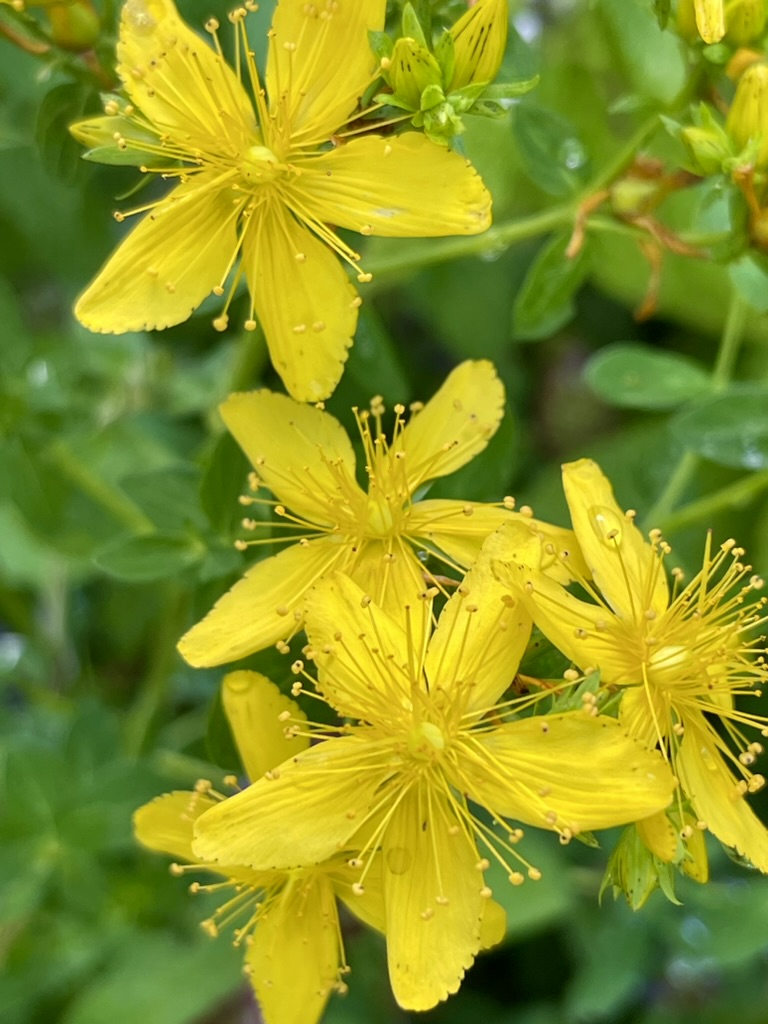
St John's Wort is a hardy perennial native to Europe and western Asia, found on sunny banks, roadsides and rough grassland. From early summer it carries clouds of five-petalled golden flowers, each one fringed with a burst of fine stamens that catch the light and draw in bees all day long.
Its botanical name gives away its most charming detail. Hold a leaf up to the light and it appears to be pricked all over with tiny holes — these are translucent oil glands rather than perforations, and they are what earned the plant the name perforatum. Rub a flower bud between your fingers and it stains them a deep red, another quirk that fascinated early herbalists, who read it as a sign of the plant's power.
The common name comes from St John's Day on 24 June, close to midsummer, when the plant is traditionally in full bloom. Bunches were gathered on that day, hung above doorways and windows, or tucked under pillows, in the belief that they offered protection from evil spirits, storms and misfortune. Few herbs carry their history quite so openly, and here at The Herbal Garden it is one of the plants visitors most enjoy hearing about.
Uses & Benefits
St John's Wort is grown here for its history, its long midsummer flowering and the pollinators it feeds rather than for the kitchen. It is a plant to learn about and enjoy looking at, with a story that reaches back through centuries of European country practice.
Culinary
St John's Wort is not a culinary herb and has no place in the kitchen. Its leaves and flowers are bitter and resinous rather than pleasant, and it has never belonged to the cooking traditions that grew up around herbs such as thyme, sage and rosemary. We grow it here purely as a garden and interest plant, where its golden flowers earn their keep by feeding bees through the height of summer.
Medicinal
Traditionally, St John's Wort was one of the best known herbs of the European country year. The flowering tops were gathered around St John's Day and steeped in oil in a sunny window, where they slowly turned the oil a deep ruby red, and this red oil was kept in the household for use on the skin. Old herbals also record it being taken as a tea to lift the spirits, and it was long carried as a charm against misfortune. These are traditional and historical uses, shared here for interest and education only, and not as modern medical advice.
Growing & Harvesting
Growing
Give St John's Wort a sunny spot and free-draining soil and it asks for very little else. It copes happily with poor, stony ground, needs almost no watering once established and comes through Canterbury frosts without any protection at all. Cut the plants back after flowering to keep them tidy and to stop them seeding about, as they can spread enthusiastically if left to their own devices. New plants are easily raised from seed or by dividing an established clump in spring. It is worth noting that St John's Wort is considered a weed in parts of New Zealand, so we keep ours contained and never let it escape the garden.
Harvesting
I harvest the flowers on a dry morning once they have fully opened, then leave them to wilt for a short time so any surface moisture has disappeared. Rather than drying them, I place the fresh flowers into a clean glass jar and cover them with oil. Over the following weeks the oil gradually turns a rich ruby red as it draws out the plant's natural pigments. This beautiful red-infused oil is one of the ingredients I use when making my Wound Repair Salve. Although St John's Wort can be dried for later use, I prefer to work with the fresh flowers whenever they are in season.
Cautions
St John's Wort is a lovely plant to grow and to learn about, but it is one to admire rather than to experiment with. It is well known to interact with a number of prescribed medicines, which is why it should never be taken without proper advice from a doctor or a qualified herbal practitioner. It can also make some people and grazing animals more sensitive to strong sunlight. In parts of New Zealand it is classed as an unwanted plant, so please check your local council rules before planting it and keep it from seeding into the wider countryside. Everything shared here is offered for interest and education rather than as medical advice.