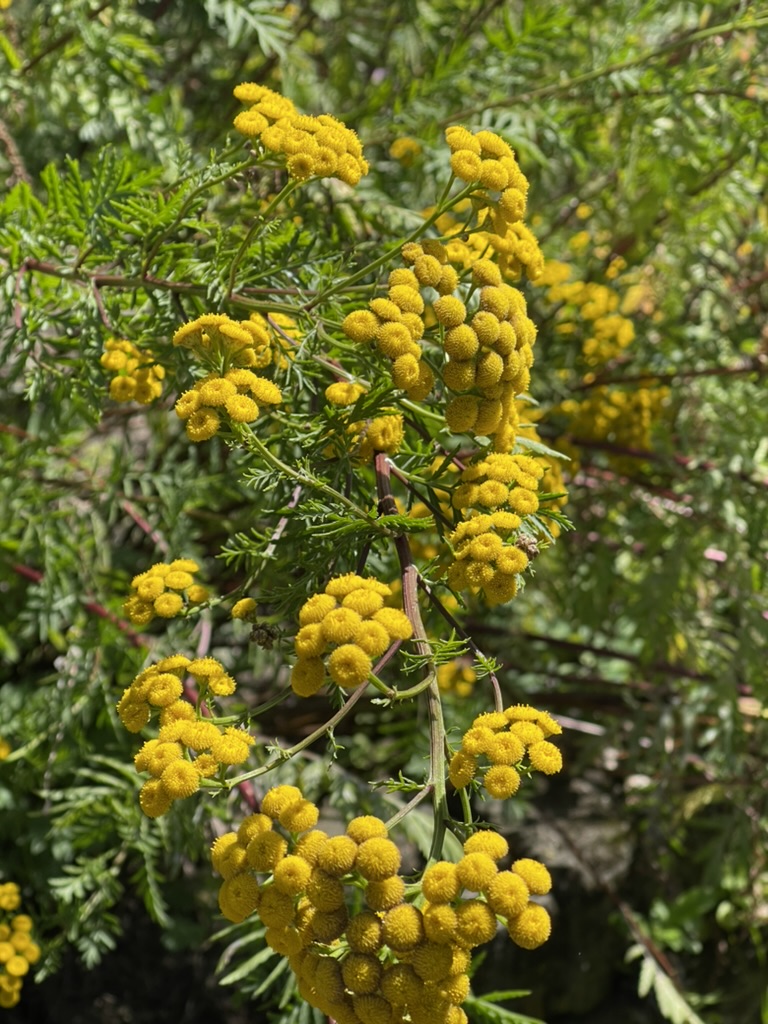
About Tansy
Tansy is one of those plants that seems to belong to another century. Tall upright stems carry deeply cut, almost fern-like leaves, and from late summer they are topped with clusters of flat golden buttons — flowers without petals, like little discs of pressed sunlight. Brush against the foliage and it releases a sharp, camphor-like scent that is impossible to mistake for anything else.
For centuries tansy was a staple of monastery physic gardens, and from there it made its way into cottage gardens across Britain and Europe. It was one of the herbs an ordinary household could rely upon: hardy, generous and always there by the door. Its name is thought to come from the Greek athanasia, meaning immortality — a reference, some say, to the remarkable way the golden flowers hold their colour long after they have been cut and dried.
Much of its old reputation came from its scent. Tansy was the great household insect herb, hung in bunches inside doorways, laid in larders and among stored linen, and strewn across earthen and flagstone floors so that every footstep released its aroma and kept flies and other insects at bay. It was often planted deliberately beside kitchen doors and dairies for exactly this reason, and old records show it was valued as much for keeping a house sweet as for anything it did in the pot.
Today we grow tansy here for its beauty and its history rather than for the household or medicinal roles it once filled. It is a splendid late-summer plant, alive with hoverflies, bees and beneficial insects when the golden flowers open, and it earns its place as an ornamental, wildlife-friendly heritage herb — one to admire, to learn from and to enjoy, rather than to use.
Uses & Benefits
Tansy has one of the longest and most colourful histories of any herb in the garden, though the way it is valued has changed a great deal. Once a working household plant, it is now appreciated chiefly as an ornamental and wildlife herb, a wonderful cut and dried flower, and a living link to the monastery and cottage gardens it came from.
Culinary
Tansy once had a genuine place in the kitchen. In medieval and Tudor England a little of the bitter juice was beaten into egg dishes to make a tansy — a green pancake or baked custard eaten at Easter, at the end of Lent, when bitter herbs carried both flavour and symbolism. It also appeared in puddings, cakes and small ales. We do not cook with it here, and we would not suggest that anyone does: the plant contains thujone, which is not something to be eating, and modern cooks have far better bitter herbs to choose from. It is a piece of culinary history worth knowing rather than a recipe to revive.
Medicinal
Traditionally, tansy was a busy herb in the old herbals, recorded for digestive complaints, for expelling worms and as a strewing and insect herb about the house. Bunches were also tucked among stored cloth and dried goods. These are historical uses, shared here for interest, and they are firmly in the past: tansy is now understood to be too strong for home use and is not a herb we recommend taking in any form. Where it still earns its keep is out in the garden, where its aromatic foliage is a traditional companion plant near doorways, and where the flowers feed hoverflies, ladybirds and other helpful insects that quietly look after the beds for us.
Growing & Harvesting
Growing
Tansy could hardly be easier. It is a tough, hardy perennial that takes Canterbury frosts in its stride, dying back in winter and returning strongly each spring. Give it full sun and almost any soil that drains reasonably well, and once established it needs very little water. The one thing to know is that it spreads: creeping roots travel further each season, and self-sown seedlings appear if the flower heads are left standing. We give it a spot with room of its own, well away from smaller herbs, and lift the wandering roots each spring to keep it within bounds. In a smaller garden it is well worth growing in a large container or a sunken bucket instead. The tall stems may need a little support in an exposed position.
Harvesting
I cut stems throughout the summer while the flowers are fresh and tie them into small bunches. These are hung straight away in the chicken coop, where tansy's strong aromatic scent has long been valued as a traditional way to help discourage flies and mites. The cheerful golden flowers also brighten the coop, making this one of the few herbs I harvest primarily for its practical use around the garden rather than for the kitchen or medicine cabinet.
Cautions
Tansy is a beautiful plant but a genuinely strong one, and it is best enjoyed with your eyes rather than taken internally. The whole plant contains thujone, a naturally occurring compound that can be toxic in even modest amounts, which is why the old internal uses have long since been set aside — and why tansy should never be used by anyone who is pregnant or breastfeeding. Handling the foliage can cause skin irritation or a rash in sensitive people, so we wear gloves when cutting or dividing it, and it is worth siting it away from paths where children play. Being in the daisy family, it may also bother anyone who reacts to chamomile, feverfew or ragweed. Do bear in mind too that it can be poisonous to grazing animals. None of this makes it a plant to avoid in the garden — simply one to grow, admire and understand. Everything shared here is offered for interest and education rather than as medical advice.