About Turkish Sage
Despite its common name, Turkish Sage is not a true sage at all. It belongs to no part of the Salvia family, but to the wider mint family, and it earns its name from the soft, sage-like look of its leaves rather than from any relationship to the sages of the kitchen garden. It is one of those plants that quietly anchors a border, holding its shape and presence long after showier neighbours have come and gone.
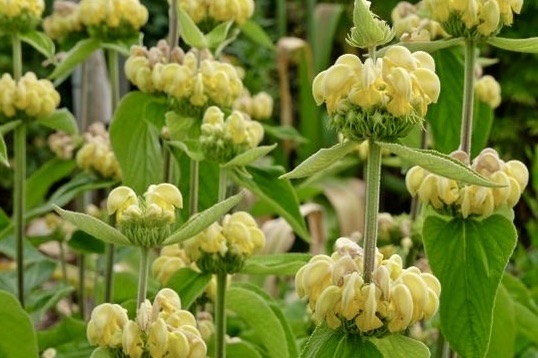
The foliage is bold and generous, large heart-shaped leaves in a soft grey-green, covered in fine hairs that give them a felted, almost woollen feel. From these low rosettes rise tall upright stems carrying tiered whorls of buttery yellow flowers, spaced like little candelabra all the way up. They create wonderful architectural interest right through summer, and the bees adore them. Best of all, when the flowers have faded the seed heads remain, standing handsomely through autumn and well into winter, catching frost and low light and giving the garden structure at a time of year when so much has retreated underground.
Turkish Sage is native to Turkey and neighbouring parts of western Asia, where it grows on open, sunny hillsides. It has long been grown as an ornamental rather than a culinary or medicinal herb, and that is exactly how we grow it in our garden. We grow it for its beauty, its remarkably long season of interest and its value to bees and other pollinating insects, rather than for anything it might offer the kitchen or the medicine cabinet.
Uses & Benefits
Culinary Uses
Turkish Sage is not a culinary herb, and in spite of its name it should never be treated as a substitute for garden sage in the kitchen. It has no tradition of use in cooking, either here or in its native Turkey, and its leaves have none of the warm, savoury flavour that makes true sage such a kitchen favourite. Its contribution is entirely a visual one, and a very generous contribution it is — bold foliage, months of buttery yellow flowers and seed heads that carry the garden through winter.
Medicinal Uses
Turkish Sage has no established place in traditional herbal medicine and is not used as a medicinal herb at The Herbal Garden. While a number of related Phlomis species have appeared in regional folk traditions across western Asia, Phlomis russeliana itself has been grown almost entirely as an ornamental.
What it offers instead is a different kind of value: a long, dependable flowering season that keeps bees, bumblebees and other pollinating insects well fed through the height of summer. A garden that hums with insect life is a healthier garden, and this is a plant that earns its place many times over on that account alone.
Everything shared here is offered for interest and education rather than as medical advice.
Growing & Harvesting
Growing
Turkish Sage is a tough, undemanding perennial that asks for an open, sunny position and soil that drains freely. It copes well with dry summers once it is established, spreading slowly into broad clumps of felted foliage, and it is perfectly hardy through Canterbury frosts. Given room and light it needs very little from the gardener beyond the occasional tidy.
Harvesting
Turkish Sage is not grown for the kitchen or the medicine cabinet. As it is still a relatively new addition to the garden, I simply enjoy it for its beautiful flowers and architectural seed heads. I leave these standing through autumn and winter, where they continue to add structure to the garden and provide shelter for beneficial insects, before cutting the old stems back in early spring as fresh growth begins.
Cautions
The most important thing to say about Turkish Sage is simply that the name can mislead. It is not a true sage and it is not a food plant, so it should never be gathered for cooking or for herbal preparations on the strength of its name alone — a good reminder to always know a plant by its botanical name as well as its common one. The softly hairy leaves may irritate very sensitive skin, so a pair of gloves is sensible if you are dividing or cutting back a large clump. Everything shared here is offered for interest and education rather than as medical advice.