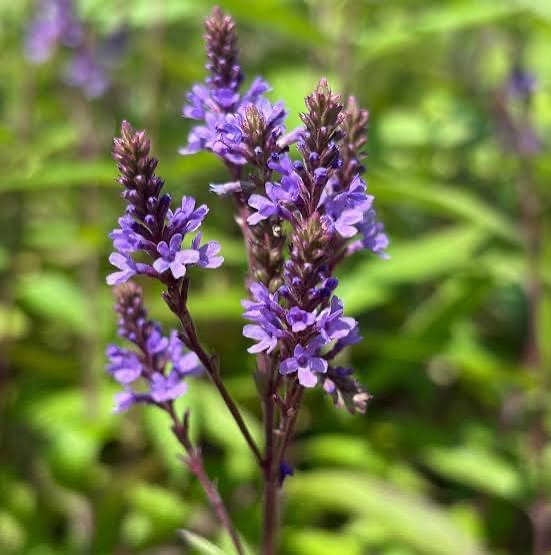
About Vervain
Vervain is one of those herbs that could easily be walked past without a second glance. It sends up wiry, square, branching stems to about waist height, carrying rough-textured leaves and long, thin flowering spikes studded with tiny pale lilac flowers that open a few at a time from the bottom upwards. There is nothing showy about it at all, and yet it has a quiet elegance in a border and hums with small bees for weeks on end through high summer.
For a plant so modest in appearance, its history is extraordinary. The Druids gathered Vervain with great ceremony, harvesting it at particular phases of the moon and using it in blessings and rites of purification. The Romans held it in similar regard, sweeping their altars with bunches of it and carrying it on missions of peace, which is how it came by the old name herba sacra, the sacred herb.
Later, Christian folklore gave it another name still. Vervain was said to have been found growing at the foot of the Cross, where it was used to staunch the wounds of Christ, and so it became known throughout Europe as the Herb of the Cross. For centuries afterwards it was hung above doorways and tucked into pockets for protection and good fortune. Few plants have carried so much meaning on such slender stems.
Uses & Benefits
Culinary Uses
Vervain is not a kitchen herb. The leaves are distinctly bitter, with none of the aromatic oils that make thyme or rosemary such a pleasure to cook with, and it has never found a place at the stove.
It is worth saying that it is often confused with Lemon Verbena, a quite different South American shrub whose leaves are wonderfully lemon-scented and genuinely useful in the kitchen. The two share part of a name and very little else. Vervain's contribution is to the herbal tradition and to the garden itself, where its long flowering season keeps bees and hoverflies well supplied.
Medicinal Uses
Vervain has one of the longest records of any European medicinal herb, appearing in the writings of Dioscorides and Pliny and remaining a fixture in monastery physic gardens and country herbals for centuries afterwards. The whole flowering plant is used, dried and taken most often as a rather bitter tea.
Traditionally it has been valued as a calming, restorative herb — the sort given to someone worn down by nervous strain or convalescing slowly after illness. It has also been used in the older herbals to support digestion, in keeping with its bitter character, and as a gentle nervine at the end of a long day.
Much of Vervain's reputation rests on tradition and long use rather than modern research, and it is genuinely bitter to taste, so it is usually blended with sweeter herbs. Everything shared here is offered for interest and education rather than as medical advice.
Growing & Harvesting
Growing
Vervain asks for very little: a sunny position and free-draining soil suit it best, and it is quite happy on poor, stony ground where fussier plants sulk. It is a short-lived perennial in most gardens, so it pays to let a few plants set seed each year rather than tidying every stem away. Seed sown in spring germinates readily, and self-sown seedlings appear obligingly around the parent plant. Its narrow, upright habit means it slips easily between other herbs without crowding them.
Harvesting
Harvest the flowering stems on a dry morning once the dew has lifted, ideally as the first flowers begin to open. The stems can either be tied into small loose bunches and hung in a warm, airy place out of direct sunlight, or laid out on drying racks in a single layer until completely dry.
Once dry, strip the leaves and flowers from the stems and place them into a paper bag for a short time to ensure any remaining moisture has disappeared. They can then be transferred to a plastic container for long-term storage, giving added protection from moths, spiders and other garden pests while keeping the herb in excellent condition.
Cautions
Vervain is best avoided during pregnancy, as it has traditionally been used to encourage contractions and was once relied upon by midwives for exactly that reason. It is also sensible to leave it aside while breastfeeding. Because it is a bitter herb that stimulates the digestion, large amounts can unsettle the stomach, and it is worth taking care if you use blood-pressure medication or have a thyroid condition. Do also make sure you have the right plant: Vervain (Verbena officinalis) is quite distinct from Lemon Verbena, and the two are easily muddled. As always, if you take regular medication or have any concerns, have a word with your doctor or a qualified herbalist first. Everything shared here is offered for interest and education rather than as medical advice.