About Wall Germander
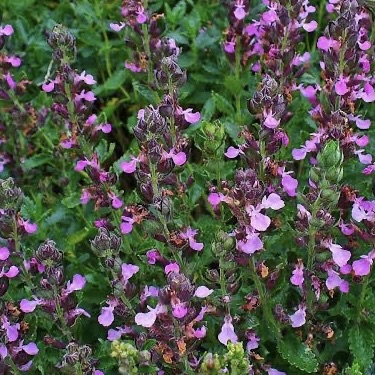
Wall Germander is a small, tough evergreen sub-shrub that rarely reaches much above knee height. Its leaves are neat and glossy, dark green with softly scalloped edges, rather like miniature oak leaves, and they stay handsome right through a Canterbury winter. In summer the whole plant is dotted with small rose-pink flowers held in little whorls up the stems, and it is then that the bees find it.
Its old reputation rests on how well it takes a clipping. Wall Germander was one of the classic edging plants of the traditional knot garden, planted in low ribbons to trace out patterns and enclose beds of herbs, long before box became the fashion. Given a trim once or twice a season it holds a crisp line beautifully, and it does the same job here — quietly, evergreen and without fuss.
The botanical name is a lovely one. Chamaedrys comes from the Greek for "ground oak", a nod to those small oak-like leaves, while Teucrium is said to honour Teucer, the first king of Troy, who is supposed to have been the first to use the plant in medicine. Today it remains one of the classic herbs for creating low evergreen borders, valued as much for its history and neat appearance as for its long association with traditional herb gardens.
Uses & Benefits
Culinary Uses
Wall Germander is not a kitchen herb. The leaves are strongly bitter and aromatic in a resinous, medicinal sort of way, and nobody would want them near a salad or a roast.
Historically, Wall Germander was occasionally used to flavour vermouths and herbal liqueurs because of its intensely bitter taste, although it is no longer regarded as a culinary herb.
Medicinal Uses
Wall Germander has a long place in the old herbals, where the bitter leafy tops were dried and taken as a tea. It was valued chiefly as a digestive bitter and a tonic, the sort of thing given to sharpen a poor appetite, and it appears again and again in the mediaeval and Renaissance texts, where it was also credited with easing gout and fevers.
Modern practice takes a very different view. Studies in the last few decades linked germander preparations with serious liver injury, and in a number of countries its internal use is now restricted or discontinued altogether. It is a good example of a herb whose traditional standing has not survived closer scrutiny.
We grow it here for its history, its evergreen structure and its flowers rather than for any medicinal use, and everything shared on this page is offered for interest and education rather than as medical advice.
Growing & Harvesting
Growing
Give Wall Germander full sun and free-draining soil and it will look after itself. It is thoroughly at home on poor, stony ground, dislikes wet feet in winter more than it dislikes cold, and shrugs off dry spells once established.
It is easily raised from softwood cuttings taken in early summer, which root readily and give you the number of matching plants you need for an edging. Space them 20–30 cm apart, and clip lightly after flowering to keep the line neat and the growth dense. An occasional harder cut in spring stops it going woody and bare at the base.
Harvesting
Cut the leafy tops on a dry morning once the dew has lifted, ideally just as the first flowers begin to open, when the plant is at its most aromatic. Take short stems from around the plant rather than shearing one side, so the edging keeps its shape.
Depending on how much you have gathered, the stems can either be tied into small loose bunches and hung in a warm, airy place out of direct sunlight, or laid out on drying racks in a single layer until completely dry. Once completely dry, strip the leaves from the stems and place them into a paper bag for a short time to ensure any remaining moisture has disappeared. They can then be transferred to plastic containers for long-term storage, protecting them from moths, spiders and moisture and keeping the herb in excellent condition.
Cautions
Wall Germander is one to enjoy in the garden rather than in the teapot. Although it was taken internally for centuries, preparations of germander have since been linked with serious liver damage, and for that reason its internal use is restricted in a number of countries. It should be avoided altogether during pregnancy and breastfeeding, and by anyone with a liver condition. Everything shared here is provided for interest and education rather than as medical advice.