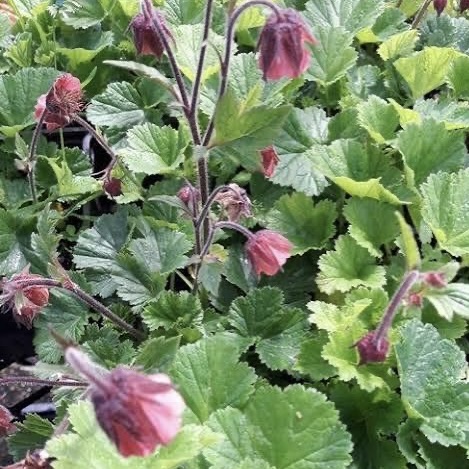
About Water Avens
Water Avens is one of the gentler herbs. It makes a low rosette of soft, slightly crinkled green leaves, and from late spring sends up wiry, reddish stems carrying nodding bell-shaped flowers in dusky pink and apricot, each one half hidden inside its own purple-brown calyx. The flowers never quite look up at you, which is part of their charm, and the bumblebees find them long before anyone else does.
It is a native European plant of damp woodland edges, stream banks and wet meadows, and the species name rivale simply means "of the brook". Scratch the root, though, and you find the reason for its other name. The roots carry a warm clove scent, sweet and spicy, and that aroma earned the plant its common name of Chocolate Root.
During the Middle Ages those dried roots were genuinely valuable. Long before imported spices became widely available, they were used to flavour ale, wine and spirits, lending a clove-like warmth to drinks that would otherwise have been very plain. Water Avens was also closely associated with monasteries, where it was grown both for its medicinal reputation and for its pleasantly aromatic roots, kept dried in the still room and drawn on through the winter.
Uses & Benefits
Culinary Uses
The culinary interest lies entirely in the aromatic root. Dried and gently simmered, it gives a warm, clove-like flavour with a faint hint of cocoa, which is where the old name Chocolate Root comes from. Historically it was steeped in ale, wine and spirits, and a small piece was sometimes added to milk or a hot drink for the sake of its spice.
Although the leaves are not used as food, the aromatic root remains an interesting reminder of a time when home-grown herbs provided many of the flavours that imported spices later replaced.
Medicinal Uses
Water Avens belongs to the rose family and, like its cousin Wood Avens, its root is notably astringent. In the old herbals it was used chiefly for that quality, taken as a decoction of the root for digestive upsets and looseness of the bowels, and used as a gargle or wash for sore mouths and minor irritations of the skin.
It appears steadily in mediaeval and later herbals, often alongside its clove-scented reputation, and it was among the plants monastery gardens kept for everyday complaints rather than for anything dramatic.
That history is interesting, but it is history. Water Avens has little place in modern herbal practice, and everything shared on this page is offered for interest and education rather than as medical advice.
Growing & Harvesting
Growing
Water Avens likes the conditions its name suggests: moist, humus-rich soil in dappled shade or gentle sun, and it is happiest along a pond edge, in a damp border or in the cooler part of a woodland planting. It will tolerate an open position provided the ground never dries out completely, but it sulks in hot, dry soil.
It is fully hardy and needs very little attention. Plants can be raised from seed sown in autumn or spring, or more simply by lifting and dividing established clumps in early spring or after flowering. Divisions establish quickly and soon form the same soft rosettes. A mulch of leaf mould in autumn keeps the roots cool and the soil moist, which is really all it asks for.
Harvesting
The leaves can be picked through the season if wanted, but it is the root that is traditionally gathered. Lift roots in autumn, once the plant has died back and the aroma is at its strongest, choosing well-established clumps and replanting a good portion so the plant continues. Wash the roots carefully, trim away any fibrous side roots and slice the main roots into even pieces before drying.
Depending on how much has been gathered, material can either be tied into small loose bunches and hung in a warm, airy place out of direct sunlight, or spread out on drying racks in a single layer until completely dry. Once dry, place it into a paper bag for a short time to make sure any remaining moisture has disappeared. It can then be transferred to plastic containers for long-term storage, protecting it from moths, spiders and moisture while keeping the clove scent in good condition.
Cautions
Although traditionally regarded as a gentle herb, the root is strongly astringent and was never intended for regular or long-term use. It is best avoided during pregnancy and breastfeeding, and anyone taking prescribed medication or living with a health condition should speak to their doctor or a qualified herbalist before using any herb medicinally. Everything shared here is provided for interest and education rather than as medical advice.