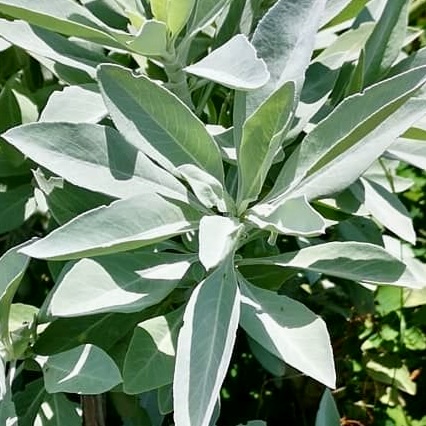
About White Sage
Unlike the familiar Green Sage of the kitchen garden, White Sage has been regarded as a sacred plant for centuries. Native to the dry deserts and coastal hills of California and north-western Mexico, it has long been used by many Indigenous peoples of North America in purification and ceremonial rituals, where the fragrant leaves are traditionally burned as part of sacred smudging ceremonies. These traditions belong to the communities who have cared for this remarkable plant for countless generations and are shared here with respect.
Its beautiful silver-white leaves, powerful fragrance and tall flower spikes make it one of the most distinctive members of the sage family.
Uses & Benefits
We grow White Sage primarily as an ornamental and aromatic herb. The beautiful silvery foliage provides year-round interest, the flowers draw bees and other pollinators through summer, and the whole plant is appreciated for its distinctive fragrance.
Culinary
Unlike Green Sage, White Sage is not generally grown as a culinary herb. The leaves have occasionally been used traditionally in small amounts, but their strong, resinous flavour means they are rarely used in everyday cooking. We leave ours in the garden rather than the kitchen.
Medicinal
White Sage has a long history of traditional use among Indigenous communities of North America, where different parts of the plant were valued within a variety of traditional practices. These are historical and cultural traditions, shared here for interest rather than as modern medical claims.
Growing & Harvesting
Growing
White Sage enjoys a hot, sunny position with excellent drainage and thoroughly dislikes winter wet. I grow mine in terracotta pots so I can provide the excellent drainage it enjoys and move the plants around the garden when needed. During summer, I often place the pots among the vegetable beds, where the beautiful silver foliage provides a striking contrast with the surrounding greenery. Once established it needs very little water, and excessive watering does far more harm than a dry summer ever will.
Harvesting
I grow White Sage mainly for its beautiful foliage and architectural form rather than for regular harvesting. I occasionally pick a few stems to enjoy their fragrance, but most are left on the plant so it keeps its natural shape and beauty. Once the leaves have dried, I sometimes wrap them around a dried Mullein flower stalk to make a fragrant garden torch. It is one of the simple traditional crafts I enjoy making from herbs grown in the garden.
Cautions
White Sage carries important cultural significance for many Indigenous peoples and should always be treated with respect. Its traditional uses belong within their cultural context, and we share them here only in passing and with care. Everything on this page is offered for interest and education rather than as medical advice.