About Wormwood
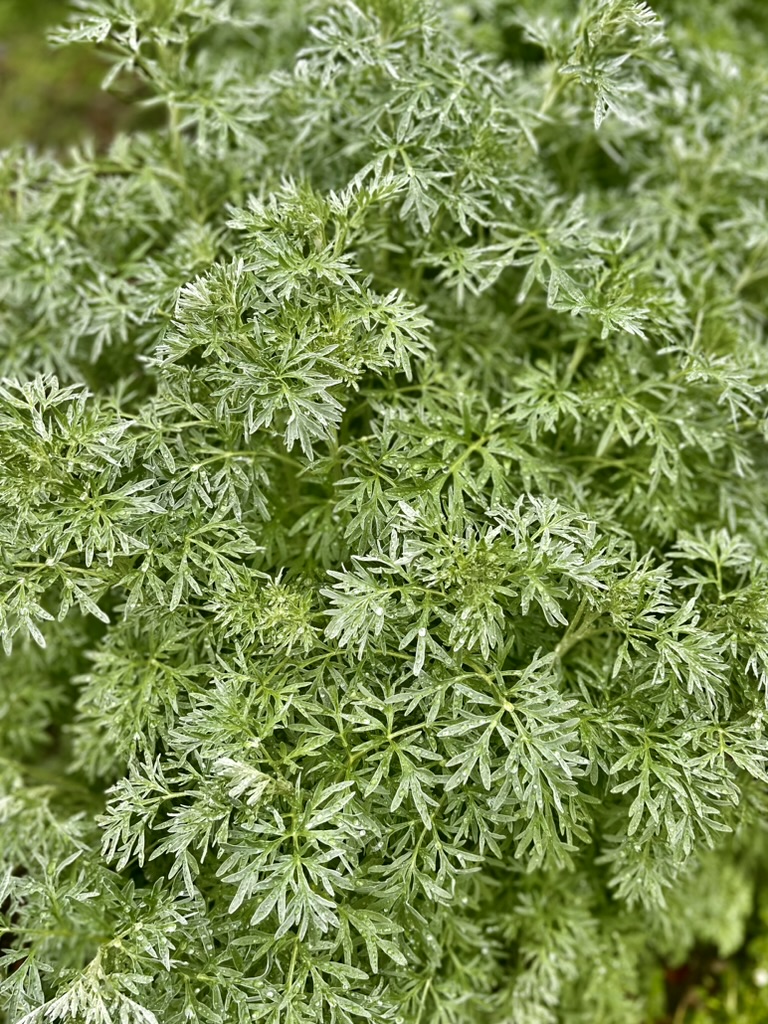
Wormwood is a handsome thing long before you know anything about it. It forms a soft mound of finely divided, silver-grey foliage that catches the light beautifully and looks especially good beside dark green leaves or deep flower colours. In late summer it sends up tall stems of small, dull yellow button flowers, modest in themselves but adding real height and movement to a dry border. Brush past it and the scent is unmistakable — sharp, clean and faintly medicinal.
It is also one of the oldest medicinal herbs we know of. Wormwood appears in Ancient Egyptian records, and it was well known to the Greeks and Romans, who valued it as a bitter tonic and named the genus Artemisia after the goddess Artemis. The species name absinthium is thought to carry the sense of "without sweetness", which is about as honest a description as any plant has been given — the bitterness is extraordinary.
Most people know it today as the principal bittering herb of absinthe, the green spirit that became famous, and then infamous, in nineteenth-century Europe. Long before that, though, it earned its keep in far more ordinary ways. It was scattered across floors as a strewing herb to freshen a room, tucked among linen and stored grain to deter moths and insects, and taken as a medicinal bitter — a use reflected in the very name Wormwood. Few herbs have quite so much history packed into a single silvery plant.
Uses & Benefits
Culinary Uses
Wormwood is not a kitchen herb. The leaves are among the most bitter of any plant grown in a herb garden, and even a small amount will overwhelm anything it is added to.
Its culinary reputation rests almost entirely on drinks. It was the defining bittering herb in absinthe, and it has also been used in small, carefully measured quantities in vermouths and bitter aperitifs, where that sharpness is the whole point. Outside of those traditions it is grown for its foliage and its history rather than for flavour.
Medicinal Uses
Wormwood has one of the longest medicinal records of any European herb. Classical and mediaeval writers used the bitter leafy tops as a digestive tonic, given to sharpen a poor appetite and settle a sluggish stomach, and it was widely relied upon as a vermifuge, which is where the English name comes from. It also appears repeatedly as a strewing herb and insect repellent, hung in cupboards and laid among stored cloth to keep moths away.
The bitterness is the active principle in the old sense: bitter herbs were believed to stimulate digestion, and Wormwood was the most bitter of them all. It remains a component of some traditional bitter preparations today, always in very small quantities and usually as part of a blend.
Modern practice treats it with considerable care. Wormwood contains thujone, which is toxic in quantity, and its internal use is regulated in many countries. Everything shared on this page is offered for interest and education rather than as medical advice.
Growing & Harvesting
Growing
Wormwood asks for very little. Give it full sun and free-draining soil and it will thrive, and it is genuinely happier on poor, stony ground than in anything rich, where it tends to grow soft and flop. Wet feet in winter are the main danger; cold on its own troubles it hardly at all.
It can be raised from seed, though it is far quicker from softwood cuttings taken in early summer, or by dividing an established clump in spring. Cut the whole plant back hard in early spring to keep it compact and to encourage fresh silver growth, as older plants become woody and open at the base if left alone. It is worth remembering that Wormwood can suppress the growth of plants close to it, so it is best given a little space of its own rather than crowded into a mixed bed.
It is also a vigorous plant. Left to flower and set seed it will self-seed very readily, and its strong root system makes a well-established clump difficult to remove once it has settled in. Here at The Herbal Garden we grow it in one dedicated area where it is kept regularly trimmed and never allowed to go to seed. That keeps it comfortably under control while still giving us its beautiful silver foliage and its traditional garden uses.
Harvesting
Rather than harvesting Wormwood for medicinal use, I mainly cut it back to keep the plant compact and prevent it from setting seed. Left unchecked it self-seeds readily, and its strong root system can make established plants difficult to remove.
The fresh leafy stems are occasionally used to make a traditional wormwood spray for my Bay hedge, which is prone to thrips. Wormwood has long been valued as a natural insect-repelling herb in the garden, and this is the way I prefer to use it.
Cautions
Wormwood is a herb to treat with respect. It contains thujone, which is toxic in anything more than very small amounts, and internal use is restricted in many countries. It should be avoided altogether during pregnancy and breastfeeding, and by anyone with a liver condition or a seizure disorder. Handling the plant can also irritate sensitive skin, so gloves are sensible when cutting it back. Everything shared here is provided for interest and education rather than as medical advice.