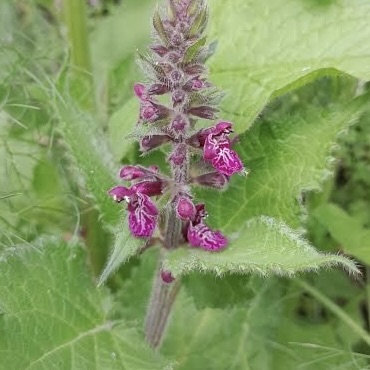
About Woundwort
Woundwort is a plant of woodland edges, hedgerows and shaded banks, and it looks entirely at home in that sort of dappled, slightly untidy company. It grows on upright square stems, typical of the mint family, with soft, hairy, heart-shaped leaves and a quiet, unassuming habit. One characteristic that often surprises people is the scent: crush a leaf and it is decidedly unpleasant, rank rather than aromatic, which is probably why it has never been much of a garden favourite.
Forgive it that, though, because the flowers are lovely. From early summer it sends up whorled spikes of deep reddish-purple, each little flower marked with paler streaks, and they carry on for weeks. Bees adore them, bumblebees in particular, and the plant hums with visitors for as long as it is in bloom. Few herbs of the shadier corners give so much back to the pollinators.
The name tells you its history. Woundwort has been valued in European herbal medicine for centuries and earned its common name because it was traditionally applied to cuts, bruises and wounds, the crushed or bruised leaves bound over an injury as a simple dressing. It was once regarded as one of the principal herbs carried by country herbalists for treating injuries, a familiar and dependable plant that could be found along almost any hedgerow when it was needed most.
Uses & Benefits
Culinary Uses
Woundwort is not a culinary herb. The unpleasant smell of the crushed leaves rules it out of the kitchen, and it has no tradition as a flavouring or a salad plant.
Although a few members of the wider mint family have occasionally been used as food, Woundwort has never been regarded as a culinary herb. Its value has always been in the traditional herb garden and in its long history as a medicinal plant rather than in the kitchen.
Medicinal Uses
Woundwort's traditional reputation is written into its name. The fresh leaves were bruised and applied directly to cuts, grazes and bruises as a simple field dressing, and the herb appears in this role throughout the old European herbals. It was also made into washes and poultices for slow-healing sores, and country practice held it in high regard for exactly this kind of everyday injury.
Beyond wound care it was used as a mild astringent and, in some traditions, as an infusion for cramps and general aches, though these uses were always secondary to its reputation as a healing herb for the skin.
Growing & Harvesting
Growing
Woundwort is easy to please. It prefers part shade and a moist, reasonably rich soil, and it is perfectly suited to the damper, shadier parts of a garden where many herbs sulk. Full sun is tolerated if the ground stays moist, but it is happier under the edge of a hedge or beneath shrubs.
It can be grown from seed sown in autumn or spring, or more easily by dividing an established clump in spring. It spreads by creeping rhizomes and will self-seed as well, so it is worth choosing its position with that in mind and lifting any unwanted growth while it is young. Cutting the plant back after flowering keeps it tidy and prevents seed being scattered too freely.
Harvesting
Although Woundwort was traditionally harvested for herbal use, I am still getting to know this plant in the garden and currently grow it mainly for its historical interest, attractive flowers and value to pollinating insects. As the plants become established, I'll discover more about how it performs in our Canterbury conditions.
Cautions
Woundwort has a long folk history but very little modern study behind it, so it is best enjoyed as a garden plant and a piece of herbal history. It is not recommended during pregnancy or breastfeeding, and handling the hairy leaves can irritate sensitive skin. Any wound that is deep, dirty or slow to heal needs proper medical attention rather than a herbal dressing. Everything shared here is provided for interest and education rather than as medical advice.