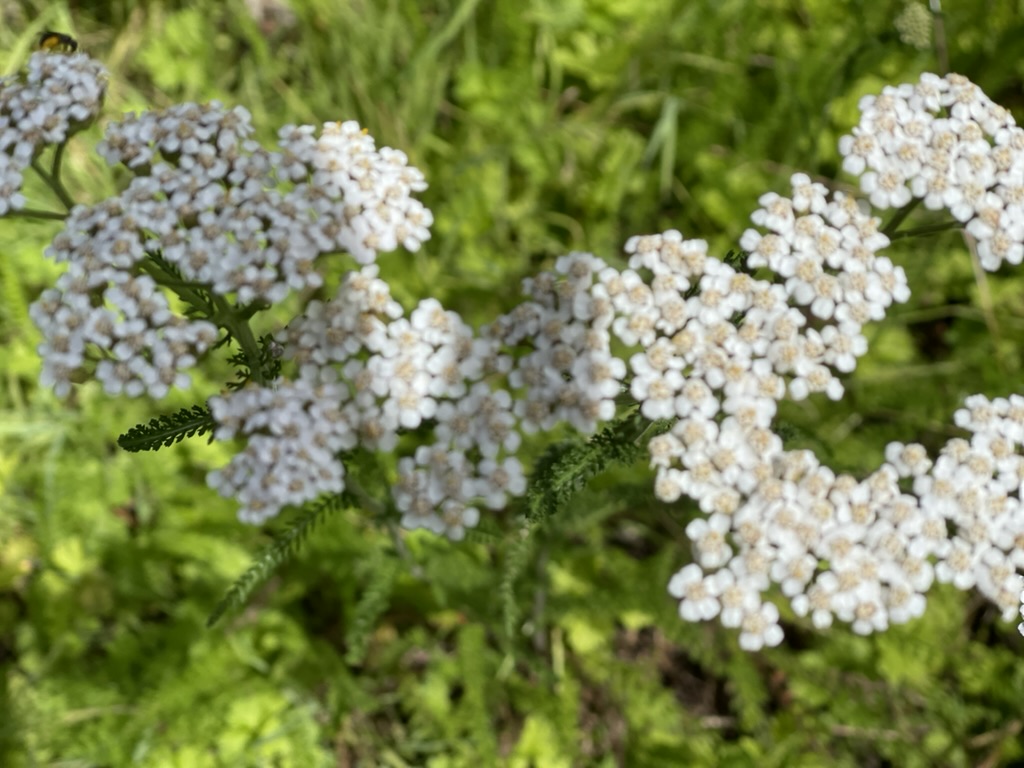
About Yarrow
Yarrow is one of those herbs that asks for very little and gives a great deal. Its finely divided, almost fern-like leaves give it the species name millefolium, the thousand leaf, and from early summer it carries flat, plate-like heads of tiny flowers in white, cream or soft pink held on wiry stems. Those flat heads act as landing platforms, and on a warm afternoon they are covered in hoverflies, bees, ladybirds and all manner of small beneficial insects. Although white is the traditional wild form, many beautiful garden varieties are now available in shades of soft pink, deep rose, yellow and other warm colours. I now grow both the classic white Yarrow along with pink and yellow varieties in the garden.
Few herbs have a longer recorded history. According to Greek mythology, Achilles is said to have used Yarrow to treat the wounds of his soldiers during the Trojan War, and it is from that story that the botanical name Achillea comes. For centuries afterwards it was known as Soldier's Woundwort and was carried by travellers, soldiers and country people alike as one of the most valued herbs for cuts and injuries — a reliable plant that grew along almost every path and field edge.
Although best known for its long history as a healing herb, Yarrow is just as valuable in the modern garden. It attracts bees, hoverflies, ladybirds and many other beneficial insects, is remarkably hardy and drought tolerant, and continues to be widely grown by gardeners and herbalists alike. Whether admired for its beauty, its usefulness or its fascinating past, Yarrow remains one of the true classics of the herb garden.
Uses & Benefits
Culinary Uses
Although the young leaves are technically edible, I don't use Yarrow as a culinary herb. I grow it for its medicinal qualities and for the many beneficial insects it attracts to the garden, rather than for the kitchen.
Medicinal Uses
Yarrow's traditional reputation rests almost entirely on wound care. The fresh leaves were crushed and pressed onto cuts and grazes to slow bleeding, which is how it came by names such as Soldier's Woundwort, Staunchweed and Nosebleed. Old herbals record it as one of the first plants reached for when someone was injured out in the fields.
It was also taken as an infusion of the flowering tops, traditionally to encourage sweating during feverish colds, and used as a bitter tonic to support digestion. These uses are long established in European herbal tradition, though they have not been the subject of much modern study.
Everything shared on this page is offered for interest and education rather than as medical advice.
Growing & Harvesting
Growing
Yarrow could hardly be easier. It wants full sun and free-draining soil, and it positively prefers ground that is poor and on the dry side — rich, well-fed soil produces soft, floppy growth that needs staking. Once established it is remarkably drought-tolerant and fully hardy, shrugging off frost without complaint.
It can be raised from seed sown in spring, though the quickest route is to divide an established clump in spring or autumn; every division takes readily. It spreads by creeping rhizomes and self-seeds freely, so it is worth giving it a place where it can roam a little, or lifting stray growth while it is young. Cutting the plants back after the first flush of flowers keeps them tidy and often brings a second show later in the season.
Harvesting
Gather the flowering tops in summer, once the flat heads are fully open, choosing a dry morning after the dew has lifted. Cut the stems from around the clump rather than shearing one side, so the plant keeps its shape and carries on flowering for the insects. Leaves can be picked at any time through the growing season.
Depending on how much has been gathered, the stems can either be tied into small loose bunches and hung in a warm, airy place out of direct sunlight, or laid out on drying racks in a single layer until completely dry. Once dry, strip the leaves and flowers from the stems and place them into a paper bag for a short time to ensure any remaining moisture has disappeared. They can then be transferred to plastic containers for long-term storage, protecting them from moths, spiders and moisture while keeping the herb in good condition.
Cautions
Yarrow belongs to the daisy family, so anyone sensitive to daisies, chamomile or ragweed may find it causes a reaction, and handling the foliage in strong sunshine can occasionally make skin more prone to burning. It is not recommended during pregnancy or breastfeeding, and it is best avoided by anyone taking medication that affects blood clotting. Everything shared here is provided for interest and education rather than as medical advice.